
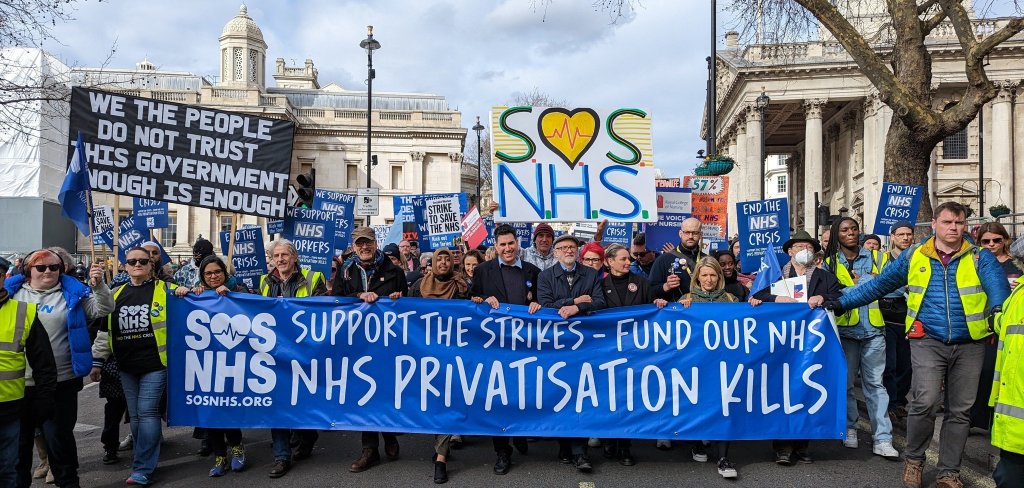
In July 2025, the Labour government published a 10 Year Plan for Health. Keep Our NHS Public welcomes mid- and long-term planning for our population health and for the NHS. However, there are a number of significant problems with the 10 Year Plan as it currently stands.
THREE SHIFTS IN HEALTH CARE
The government wants to see three main shifts in health care:
- From sickness to prevention
- From hospital to community
- From analogue to digital.
Preventing Ill health
The Plan rightly emphasises the importance of preventing ill-health in the first place and of preventing health conditions from worsening. The government states it wants a plan for health rather than for the NHS.
BUT the government’s promise to prioritise prevention is not backed up with the necessary resources to strengthen public health, one of the most poorly funded aspects of our health system. The wider social factors which contribute to poor health such as poverty and poor quality jobs and housing are largely ignored. Even safe staffing levels which would reduce the stressful working conditions of NHS staff are not mentioned. The annual survey on population health will no longer be commissioned by government.
Shifting care into community settings
The Plan promises to move more care out of hospital and to expand care based in community settings, especially neighbourhood centres, a move which many patients would welcome for reasons of convenience.
BUT there is nothing new about this vision. Neighbourhood health centres were introduced almost 20 years ago but faced problems of duplication and wasted resources. Numerous initiatives have attempted to move more care out of hospitals with mixed results at best. And yet there is little in the Plan which spells out the lessons learned from previous failures and why initiatives in the new Plan will work this time round. These include government failure to provide a properly resourced social care service. We must also remember that patients will continue to need hospitals and these must be properly funded.
Is technology the answer?
The Plan has a bold vision of an NHS which offers a speedier, more efficient service powered by modern technology. It envisages wider uses of the NHS App, Artificial Intelligence to write up the notes of consultations and a genomic population health service to improve prediction of future illness.
BUT the Plan fails to acknowledge the over-stated benefits and under-stated risks and harms and the wasted expenditure often associated with unproven technology. The government is promising to shift from public healthcare workers to private sector hi-tech. Meanwhile the social changes we need to prevent ill-health and improve health, like rapid steps to reduce child poverty, are largely overlooked. And while increased digitalisation can have many benefits, it risks excluding millions of people who can’t afford the internet or electronic devices or cannot use such technology confidently or face barriers such as disability or language differences.
FURTHER WEAKNESSES IN THE 10 YEAR PLAN
Another top down reorganisation
The government has decided to reorganise the NHS – again! – partially abolishing arrangements put in place only three years ago, slashing the integrated care boards which have been trying to foster more integrated care,throwing thousands of people out of their jobs and reintroducing American inspired ‘integrated health organisations’. The re-organisation is a major distraction, drawing focus, staff expertise, time and resources away from patient care.
Funding
There is no transformation funding for the far-reaching vision and numerous promises are unfunded. When bringing about an unproven change in health care, existing services must continue alongside a newly designed replacement service to ensure that the first is not closed down before the second is known to work effectively. For example, no-one knows that expanding urgent care in Neighbourhood Health Centres will end the crisis in A&E which is caused at least in part by too few beds and inadequate social care. There is no money for this. When the then Labour government reorganised the NHS in the 2000s it promised annual increases in funding of almost 7% to manage the change; now funding increases are barely 3%, well below the historic average. Funds will be taken away from existing services to spend on new technology. Money is being wasted on reorganisation.
Evaluating
Despite the scale of the plan and the scores of initiatives it outlines, there is no programme of evaluation. Perhaps this is because the government itself is not confident its plan will work.
Privatising
The Plan offers a bonanza for the private sector. Market competition with private providers is back, along with billions to be spent on expanding private health companies providing elective care. Integrated Health Organisations, which will be expected to control much of the local budget, will be encouraged to form partnerships contract the services of private providers. The services in neighbourhood centres are likely to be provided by a range of providers. Purchasing Apps, AI, monitoring tools and other technology will transfer billions of pounds to the tech companies, some of which have troubling track records in the field of human rights. Neighbourhood centres are to be built through public-private partnerships and the push to get private finance to fund capital investment threatens the return of some version of the disastrous Private Finance Initiative for hospitals, costing twice as much as government borrowing. PFI hospitals were built with far fewer beds on the false assumption that care in the community meant they would not be needed.
Delivery
The government has an ambitious vision of faster diagnosis and faster treatment and the Plan is chocked full of initiatives. But there is no delivery plan and the top-down reorganisation being imposed by government removes some of the existing structures supporting partnership working.
IN CONCLUSION – VISION VERSUS REALITY
While the 10 Year Plan sets out a grand vision, the reality will be more privatisation, deskilling of staff and reliance on technology. Without adequate funding and a strong social care sector, a properly functioning NHS, weakened by a decade of austerity and a pandemic, cannot be restored. The absence of a proper evaluation programme means that policy makers will struggle to learn from their mistakes.
 saveournhsleicestershire.uk
Leave a comment